What this service covers
An active soil depressurization system sized to the foundation in front of it: a full basement, a walkout cut into a hillside, a slab, a crawl space, or some combination. Every install in Colorado is performed under the state mitigation license that DORA has required since July 2022, follows the ANSI/AARST SGM-SF-2023 standard, and ends with a retest that proves the number actually moved.
Typical pricing
$1,200-$2,600
Pricing varies by job specifics. Free phone or on-site quotes; fixed pricing once the technician has assessed the job.
What an active system does under a Pikes Peak foundation
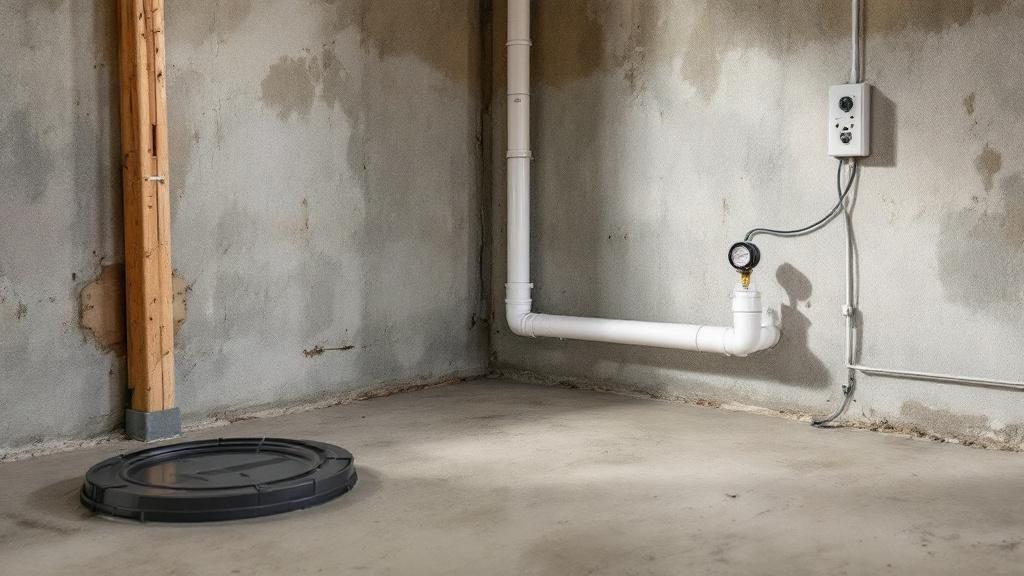
Soil gas moves toward low pressure, and in a heated house the lowest floor is the low-pressure side. Mitigation reverses that relationship at the source. A hole about the size of a coffee can is cored through the slab, a cavity is dug out beneath it, and a run of PVC carries a continuously running inline fan that holds the soil side at lower pressure than the room side. Radon that would have seeped through the slab rides the pipe past the eave instead.
The EPA's Consumer's Guide to Radon Reduction rates active sub-slab depressurization at 50 to 99 percent reduction, the top range among the soil-gas methods it lists, which is why it anchors nearly every install here. The granite-derived gravels under much of El Paso County are porous enough that one well-placed suction point often treats an entire footprint, though the only way to know is a diagnostic test with a vacuum and a micromanometer before any pipe is glued.
Sealing is the supporting act. Open joints, slab cracks, and utility penetrations get closed so the fan spends its effort on the soil rather than pulling conditioned air out of the house, a cost that matters through a Front Range heating season. The route, the fan model, and the suction points are written into the quote before work starts, and the cost guide shows how each choice moves the price.
What Colorado licensing means for your install
Since July 1, 2022, Colorado law (C.R.S. Title 12, Article 165) has required anyone performing radon measurement or mitigation for pay to hold a state license from DORA's Office of Radon Professionals, issued on top of a current NRPP or NRSB certification. Before that date, radon work in Colorado was an unregulated trade; now an unlicensed install on a paying customer's home is illegal, and the license number can be checked on DORA's lookup in about a minute.
The license carries the national standards with it. A certified mitigator works to ANSI/AARST SGM-SF-2023 for single-family homes, which governs where the fan may sit (attic, garage with no living space above, or outdoors, never in the basement), how high the discharge must terminate, pipe sizing, labeling, and the system monitor every install needs. All contractors you work with here hold the Colorado license and a current NRPP or NRSB credential.
Two practical consequences for a homeowner. First, ask for the license number on the quote and verify it; a pro who hesitates has answered the question. Second, a system installed before 2022 by an unlicensed handyman deserves a close look against the current standard, because plenty of pre-license installs in the Springs vent at ground level or run fans in basements. Our license-checking FAQ walks through the lookup.
How Colorado Springs foundations shape the design
The housing west of I-25 was built on hillsides, and hillside houses mean walkouts: one basement wall buried uphill, the opposite wall at grade with a patio door. Rockrimmon, Mountain Shadows, Skyway, and the Broadmoor bluffs are full of them. A walkout concentrates soil contact on the uphill side, so suction-point placement matters more than in a flat-lot basement, and the discharge route has to respect a roofline that steps down the slope.
East of the interstate the story changes by decade. The Old North End and the near-downtown grid hold pre-1940 houses with rubble-stone foundations, dirt-floor cellars, and additions over crawl spaces, which usually need a membrane and generous sealing. Security-Widefield and the central postwar belt run to ranches over slabs and shallow crawls. Briargate, the Powers corridor, Falcon, and Monument are dominated by post-1990 two-stories with poured full basements, the most straightforward case, and many newer ones carry a builder's passive rough-in pipe that only lacks a fan.
Underneath all of it sits weathered Pikes Peak granite and the sediments shed from it, which the USGS identifies as uranium-bearing. Gravelly decomposed granite is permeable, so gas moves to the foundation easily, and it also communicates well under a slab, which keeps many installs to a single suction point. See the community-by-community table for how this plays out across the region.
The paperwork and the proof behind every system
A quote here is written after someone has looked at the foundation, not read off a ZIP code. It names the suction-point count, the route, the fan, the sealing scope, the discharge location, and one fixed price, and it lists the Colorado license number of the mitigation pro responsible for the job. Most Pikes Peak basement and slab systems land between $1,200 and $2,600; crawl spaces with full membranes run $1,900 to $3,600.
The install day ends with the fan running, a manometer on the pipe marked with its startup reading, system labels in place, and the homeowner shown what a healthy gauge looks like. Then comes the part that separates a real mitigation job from a pipe sticking out of a roof: a post-mitigation test, started after the system has run at least 24 hours, confirming the indoor level actually dropped. The written result is yours to keep, and it is the document a future buyer's inspector will ask about.
Radon fans are rated for continuous duty but not for eternity; the EPA notes most carry warranties of about five years and many run well past that. The gauge tells you when one quits. When it does, a repair visit swaps the fan without redesigning anything.
Service area
Radon Mitigation Systems is available across Colorado Springs and the Pikes Peak region. Per-suburb pages: